Tuesday, March 10, 2015

Engines and the Four Thermodynamic Processes


1. Isobaric Processes result in a linear relationship between volume and temperature.
2. Isochoric processes result in a linear relationship between pressure and temperature.
3. Isothermal processes create an inverse relationship between pressure and volume.


Add caption


This is what we predicted when asked what will happen to a rubber band when heated with a blow dryer. We were wrong, and the rubber band actually contracts.

Here is a 4 step process for an engine, which is really a rubber band, that lifts cans of spinach to place them on a conveyor belt. Heating up the rubber band requires heat flow into the rubber band, and work is performed on the rubber band, causing it to contract. Heat then flows out of the rubber band, and the rubber band performs work, allowing it to elongate.

A system that turns all of the energy entering it into work in impossible. There will always be some heat lost.

The greek letter eta represents the efficiency of an engine. All efficiency ratios compare what is produced to what is required to produce. The closer to 1, the more efficient the engine is.

From 1 to 2, an ideal gas expands at constant pressure. From 2 to 3, the system decreases in pressure at constant volume. From 3 to 4, the system condenses at constant pressure again. From 4 to 1, the system returns to where it started.

The total energy of a system is threes halves the product of the systems pressure and volume. Since these state variables are known for each point, the internal energy at that point can be calculated, as well as the changes in internal energy in each transition.

For the isochoric processes, no work is performed, and the change in internal energy is due only to the heat flow. For isobaric processes, W = p(V,final - V,initial). Using the first law of thermodynamics, it is is possible to find the heat flow for each process.

A flask filled with air is placed into a cold water bath. The flask is connected to a syringe. The syringe will undergo volume changes as the air is heated. Initially, an erasure is placed on the syringe, pushing it down increasing the volume. The air is then heated, and the syringe increases its volume and witnesses an increase in pressure. Then the erasure is removed, and the syringe shoots upward briefly, but the pressure drops.
A table representing work, heat, and changes in internal energy for each of the processes described above. Temperatures were know, and the air was approximately entirely nitrogen gas. Once the number of moles present were found, nitrogren gases molar mass was used to convert this into a mass of nitrogen gas. This mass was used in Q = mc(T,final - T,initial).

Monday, March 9, 2015

Kinetic Theory and PV Diagrams

The air in a glass syringe will expand as it is dipped in hot water, causing the syringe to rise. It will condense once it's temperature drops, pulling in the syringe.

Another group also compared internal energy to a measure of how hyper a kid is. The more candy the kid has, the more internal energy he has. However, if the kid plays or monkeys around all day, his internal energy will go down.

Isochoric Processes undergo no volume change, there for there is no work done, similar to a cooling cup of coffee. The change in internal energy equals the amount of energy added. In an adiabatic process, there is no energy added, and the change in internal energy equals the work done by the system, much like the compression and expansion of a cylinder in a car engine.


From Newton's second law that force equals the change in momentum per unit of time, and since the velocity vectors only change direction, a system of gas particles exerts a force equal to (2mv)/(t,final - t,initial).v
The work done by a system as it is heated equals the volume change multiplied by its pressure. We use the volume thermal expansion formula, and the relation between volume and density to substitute for the original volume of the system.

The pressure of an ideal gas system is actually equal to 2/3 of the total energy of the system multiplied by the number of molecules per unit volume. 
Since the internal energy of a system is dependent only on temperature, an isothermal reaction has zero change in internal energy, and work equal energy. For a an adiabatic process, energy neither enters nor exits the system, and the change in internal energy equals the work done by the system.
Here is a fire syringe used to perform an adiabatic process by rapidly condensing the volume of the cylinder, which in turn raises the temperature of the cylinder effectively causing the piece of cotton inside to ignite.
The greek letter gamma represents the ratio of heat capacities of air. A final temperature of 690 K is predicted, which is well above papers flashpoint of 506 K. This means the work performed on the gas by the collapsing piston was enough to raise the temperature of the chamber above the minimum required to burn the cotton.

Friday, March 6, 2015

Gas Laws and First Law

When placing a hot aluminum can into an ice bath upside down, we correctly predicted that the can will rapidly implode. This is a result of the steam present in the can condensing rapidly into a liquid as energy is lost to the water. As this occurs, a vacuum is created, and the pressure equalizes with the outside air by condensing it's volume, thus raising the pressure.
On the left side is a list of units used to measure pressure. The calculations is for air pressure at sea level (1 atmosphere). 


Our prediction for what a graph measuring pressure as a function of volume will resemble.

This here is what the graph actually ended up looking like. To best fit the line, we used an inverse fit.

The equation best describing the line is Pressure = A/Volume + B, where A = 1409 +/- 63.04, and B = 41.37 +/- 5.748. The units of B are kilopascals (kPa). A is the value equal to the ideal gas constant multiplied by the temperature and number of moles present. As the volume rises, the pressure reaches 41.37 kPa.

Professor Mason demonstrates the effects of temperature on an ideal gas' pressure and volume.
If the volume is held constant, then as the temperature rises, then the pressure rises, and these two share a linear relationship which can best be described by the equation P = mT + b, where m = 0.2427 kPa / C, and b = 93.53 kPa.

We originally thought that the graph representing pressure as a function of temperature would look something more like this.

The Boltzmann Constant is equal to the ideal-gas constant divided by Avogadro's Number. Rather than relating pressure and volume on a per mole basis, this constant relates these on a per molecule basis, and has units of Joules per molecule kelvin

The air pressure in the air pocket of a submerged diving bell equals the pressure of the air molecules bouncing off the water, and the the atmospheric pressure combined.
We rely on the ideal gas law here to find the height of the air pocket in the diving bell problem above.
Since we know the volume, pressure, and temperature of helium inside a balloon at its maximum height, we can find the number of moles of helium present, multiply that by its molar mass, and obtain mass of helium present.

Sunday, March 1, 2015

Heat and Thermal Properties of Matter


Linear Expansion is dependent on temperature change and the coefficient of linear expansion.


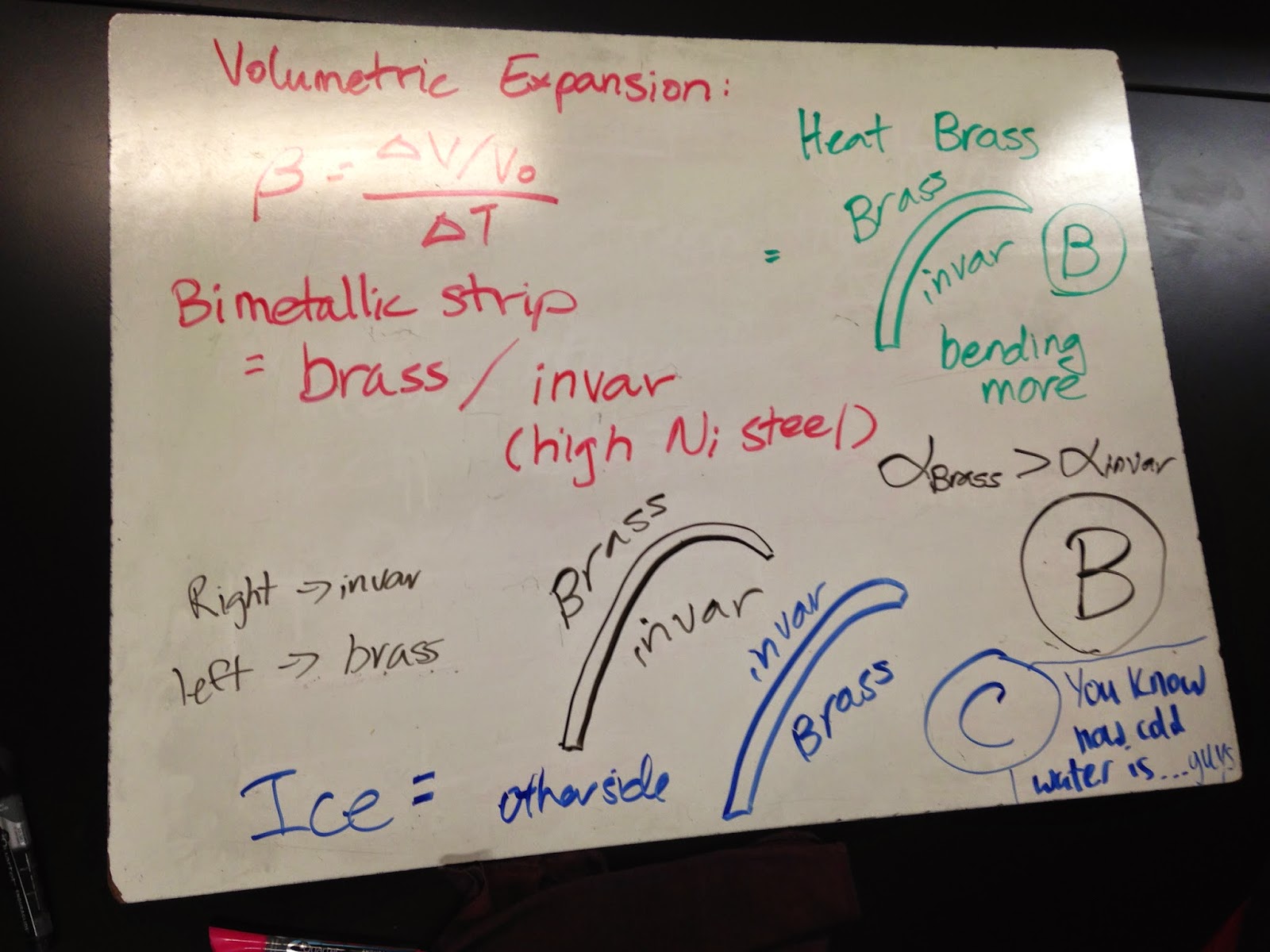
Professor heats a bimetallic strip, made up of brass and invar. The brass expands more with this introduction, therefore it is curved on the outside.

When energy is removed, the brass shrinks faster, causing it to cave in.
This student stirs a cup of water as it is heated.

In black is what we expect the relation between temperature and the addition of heat over time to look like. In green is a more accurate representation of what occurs.
As the water heats from melting to boiling temperatures, the change in its temperature over the amount of time is linear, but it slows gradually near the phase changes.
After 60 seconds of boiling, 80 g of water had been boiled away. The change in energy over time equals the change in mass over time multiplied by the waters heat of fusion. We calculate the heat of fusion to be 220 joules per kilogram.


Steam heats up one end of a steel rod.
As the rod absorbs energy from the heat, it elongates, causing a wheel to rotate on the right end of the rod a distance equal to the change in length of the rod.

After a change of 76.7 degrees Celsius, the rod rotates through 0.192 radians. The change in length of the rod is equal to the radius of the wheel multiplied by its angular displacement. The coefficient of linear expansion is calculated to be 19 X 10^6  per degree Celsius.


For steel's coefficient of linear expansion, we calculated it to be 1.9 * 10^-5 per degree Celsius with an uncertainty of 0.9517 * 10^-5 degree Celsius. This encompasses the actual accepted value which is 1.2 * 10^-5 per degree Celsius.
Our calculations for the final temperature of a 790 g block of ice at -5 degrees Celsius after 215 kj are added to it. The heat is enough to bring the ice up to melting temperature, creating an ice bath.
We calculate that 850 g of water at 22.0 degrees Celsius is the amount of water that will freeze to a final temperature of 0 degrees Celsius when poured over a 255 gram block of ice at -12.0 degrees Celsius.


As I blow into a straw filled with water, the water rises on the other end.
The pressure needed to raise an amount of water in a tube by a given height is equal to its density multiplied by the height change and gravity.